


Basket
Loading...
There are four main ways to ensure a cabinet is well ventilated, one of which uses natural convection and the others employ fans to create forced convection.
Ensuring a cabinet is well ventilated and cool is vital for protecting the equipment it houses. There are four main ways to achieve this in terms of airflow, one of which uses natural convection and the others employ fans to create forced convection. Which one you choose depends on the space around the cabinet and the temperatures inside and outside the cabinet.
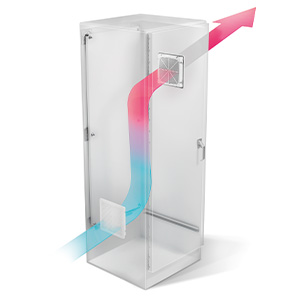
If the thermal load (amount of heat to be removed) inside the electrical cabinet is relatively low, the use of two exhaust filters can be an effective solution. However, this offers a limited cooling effect compared to forced convection.
As in the picture, the installation of two filters, one at the bottom and one at the top, allow the electrical cabinet to be cooled by natural convection, since the hot air tends to rise upwards.
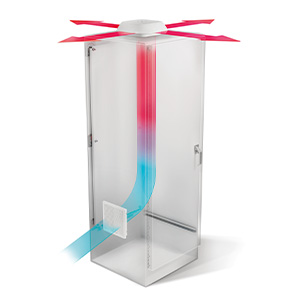
The same effect is achieved by positioning a filter in the lower part of the cabinet and a roof exhaust unit without a fan at the top of the cabinet.
When the internal thermal load is greater (if the equipment gives off a more considerable amount of heat), it is necessary to use a forced ventilation system. The following three different configurations boost airflow to better ventilate and cool the cabinet.
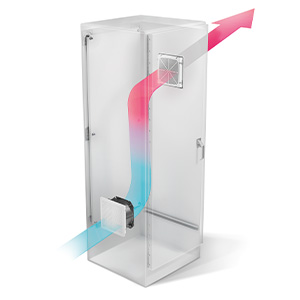
The most commonly recommended solution is to use a standard flow filter fan unit to suck cool air into the enclosure from the bottom of the panel, as pictured, combined with an exhaust outlet at the top mounted on the opposite wall. The fan forces the cool air to move inside the cabinet whilst the exhaust filter ejects hot air to the environment by induction.
This configuration takes in the air from the outside, generating a slight overpressure compared to the external environment. The positive pressure kept inside the enclosure helps expels dust from any gaps. Furthermore, the life of the fan is extended as cool external air is passed over the motor within the fan rather than the warmer air from inside the cabinet.
The thermographic image shows the temperature distribution inside the cabinet with a thermal load dissipated in the middle of the cabinet. The airflow is more natural thanks to convection.
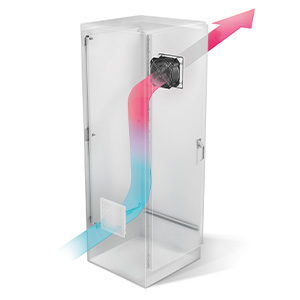
An alternative method to effectively control the temperature in an enclosure is to pull the warm air out near the top using a reverse flow filter fan, while cooler air is drawn in through a standalone filter at the bottom of the cabinet on the opposite wall.
This configuration greatly improves the air flow rate compared to the previous two methods, in fact the total air flow rate is comparable to that declared in open air.
The airflow is more even throughout the enclosure, because of a constant negative pressure. This means there is less turbulence in the airflow and a more consistent pressure, but the lifetime of the fan will be reduced as it only extracts warm air.
The final option is to mount a roof extraction unit to the top of the enclosure, creating forced convection with an integrated fan or relying on natural convection without a fan. Cool air is drawn inside through one or more filter inlets allowing a change of air and heat dissipation.
When used with a fan inside the roof mounted unit, this provides a highly effective solution to improving internal airflow. The roof fan units are equipped with a backward curved centrifugal motorised impeller which outperforms standard axial fans of a similar size on filter pressure loss.
A roof unit is particularly beneficial when space is restricted; when some side walls of the cabinet are covered by obstacles, walls or other panels.
Whichever solution best suits the application, effective cabinet cooling starts with protecting the enclosure from dust and other contaminants. Filtering incoming air helps safeguard internal components, while accurately calculating the required airflow against the thermal load ensures the cabinet remains at a safe operating temperature. Maintaining the correct internal temperature is essential to prevent component damage and extend service life, ultimately determining the most suitable cooling solution for the application.


